
Installation Guide
How a professional festoon install actually happens
Festoon lighting looks simple: bulbs on a string. The installs that photograph beautifully and run all night without a flicker are anything but. Here's the full process — site visit, rigging, spans, power and packdown — from the crew that does it every week across the Gold Coast, Byron Bay and Brisbane.
The Overview
What you're actually paying for when festoon is installed properly
When you hire festoon from us — say the $895 package with 60 metres of lighting — the price includes delivery, installation and packdown. It's worth understanding what that installation part involves, because it's where the difference between a professional result and a sagging DIY string lives.
Our festoon is LED Edison-style: the classic round filament-look bulb, but LED inside, running warm white at 2700K. Each 5 metre string carries 25 bulbs at 20 centimetre spacing and draws just 20 watts, and the whole system is IP65 rated, meaning it's sealed against rain and dust. Every string and fixture is tested and tagged before it goes on a truck. That's the gear. The install is what turns the gear into the look: straight runs, even sag, hidden cabling, and light exactly where the event needs it.
A typical install takes 2 to 3 hours with our crew on site, and it follows the same sequence every time: confirm the plan against the real site, set the rigging, fly the catenary wire, attach and tension the festoon, run and test power, then walk the whole install as guests will see it. Packdown reverses it after your event, usually the next morning. The rest of this guide walks through each step, because clients who understand the process brief us better and get better results — and if you're comparing options first, our festoon lighting hire page covers the packages themselves.
One thing worth saying up front: none of this process exists to make hire feel complicated. It exists because festoon is overhead lighting at a live event — tensioned cable and glass-look bulbs above your guests for six or eight hours. Done properly, it's completely uneventful. The process is what makes it uneventful.
Step One
Site visit and measurement: where good installs are actually decided
Every install starts with understanding the site, and for anything beyond a straightforward space that means a visit or, at minimum, good photos and measurements from you. We're checking four things.
- Distances: festoon is ordered and rigged in real metres, so we measure the actual spans — tree to tree, wall to pole position, corner to corner. "About 20 metres" that turns out to be 28 is the most common reason DIY quantities come up short.
- Anchor points: what exists to rig from, and what it can carry. A structural beam, a mature tree and a fence post are three very different anchors, and only two of them are usable.
- Power: where the outlets are, what else shares those circuits on event night, and whether the distances work — more on the 50 metre rule below.
- Access: how close vehicles get, whether there are stairs or lifts, and what the venue's bump-in window is. Access shapes crew size and timing more than clients expect.
From that we produce a plan: run lengths, pole positions if needed, power feed points and an install schedule. For weddings and styled events this folds into the broader design conversation — our event lighting design service covers festoon alongside every other layer. Quotes come back within 24 hours of an enquiry through our contact page, and a well-measured brief is what lets us hold that turnaround.
Step Two
Rigging: catenary wire, gripple locks, and when we bring our own poles
Here's the part most people don't know: professional festoon almost never hangs from its own cable. The load is carried by a separate catenary wire — a tensioned stainless steel cable flown between the anchor points first — and the festoon is then attached to that wire along its length. The lighting cable carries electricity; the catenary carries the weight. That separation is why professional runs stay straight and level for the whole event, while a festoon string hung by its own cable stretches, droops and strains its connections within hours.
We tension the catenary with gripple locks — small one-way cable locks that let us pull the wire to the right tension and hold it there without knots or clamps. They're fast to set, precise to adjust, and just as fast to release at packdown, which is part of how an install that took 2 to 3 hours comes down in a fraction of that.
When the site has nothing to anchor to, we bring the structure: freestanding poles on weighted bases, positioned to the plan from the site visit, with the catenary flown between them. Raised 3 metre beams ($200) lift runs over dance floors, walkways and service paths so no guest ever ducks under a cable. Trees make excellent anchors when they're mature and sound — we sling them with protective strapping rather than fixing anything into the timber, the same method behind our outdoor tree lighting installs. Every anchor decision comes down to one question: can it carry the tensioned load safely above people. If the answer isn't a confident yes, we rig differently.
Step Three
Spans and sag: the geometry that makes festoon photograph well
The romance of festoon is the gentle curve — the swag — between attachment points. That curve is a design decision, not an accident. Too tight and the run looks like powerlines: technically neat, emotionally flat. Too loose and it reads as droopy and unfinished, and long spans start swinging in coastal wind. The professional target is an even, repeated swag across every span, which is only achievable when the catenary tension and attachment spacing are consistent — another reason the separate wire matters.
Span length drives everything. Short spans of 5 to 8 metres between points give a tidy, rhythmic look that suits courtyards and marquee interiors. Long spans of 15 to 25 metres give the dramatic single sweep that makes beach and headland venues look cinematic, but they need serious anchor points and proper tensioning because the loads grow quickly with distance. Height matters too: we rig so the lowest point of the sag sits well clear of head height, typically brought up over dance floors and walkways with raised beams.
This is also where quantity gets real. A zigzag canopy over a dining area consumes far more metres than the straight-line distance suggests — a 10 by 15 metre area can comfortably absorb the full 120 metre package ($1495) once the crossing pattern and sag are accounted for. It's why we quote from measurements rather than vibes, and why our wedding festoon lighting installs are planned on paper before a single bulb goes up.
Step Four
Power: the 50 metre rule and why we plan circuits before install day
Festoon power planning is simple to state and constantly ignored: we run a maximum of 50 metres of festoon per power source. Past that point on a single feed, voltage drop starts to show — bulbs at the far end run dimmer than bulbs near the plug, connections work harder than they should, and the install stops being reliable. So a 120 metre canopy is fed from three points, a 200 metre install ($1945) from four or more, each run home to its own feed.
The load itself is small. At 20 watts per 5 metre string, 50 metres of our LED festoon draws 200 watts — a third of an old toaster. The planning problem is never total draw; it's distribution and sharing. On event night your circuits are also feeding the caterer, the coffee machine, the band and the bar fridge, and it's always the kettle that trips the breaker, taking the lighting down with it. We map which circuits the lighting uses at the site-visit stage so that doesn't happen at 8pm on your wedding day.
Two power add-ons come up constantly. The dimmable controller ($145) puts the whole install on a dimmer, so the canopy can drop to a low glow for speeches and lift again for dancing — the single best value upgrade we offer. And for off-grid sites, generator feeds work fine with LED festoon's light draw; we position and cable the generator so it's neither audible nor visible from the tables. Because everything is IP65 rated and tested and tagged, outdoor power connections are sealed and safe in real weather, not just on a clear forecast.
Install Day
The 2 to 3 hours on site, and the packdown you never see
Install day runs to a sequence we've refined over 10+ years in AV and events. The crew arrives inside the agreed access window and walks the site against the plan first — venues change, marquees land a few metres from where the diagram said, a new garden bed appears where a pole was going. Ten minutes of confirming beats two hours of re-rigging.
Then the build: anchor points set, catenary wire flown and tensioned with gripples, festoon attached and swag evened span by span, power runs cabled and taped or matted where they cross foot traffic. Every string was tested and tagged before it left our warehouse, but we power the full install on site anyway and walk every run looking for a dark bulb or an uneven span — then we walk it once more as a guest would see it, from the entry, at eye level. That last walk is where the small adjustments happen that make the photos.
Hire is 24 hours as standard, and packdown is included in every package price. We come back after your event — usually the next morning, so nobody is pulling cables around your guests at midnight — release the tension, coil the runs, drop the poles and leave the site as we found it. Running a multi-day event or a wedding weekend? Extended rental is $145 per additional 24 hours, which is regularly cheaper than a second install. And if your event is in the Northern Rivers, our Byron Bay festoon hire runs on local stock and local crew, which is what makes tight venue windows workable.
DIY vs Professional
Why DIY festoon kits disappoint at real events
We'll be fair to DIY kits: for a permanent string over your own back deck, hung once and enjoyed for years, they're perfectly good. Events are a different problem, and the kits fail at predictable points.
- No catenary system: consumer kits hang by their own cable, so runs sag unevenly, stretch through the night and strain their connections. The tidy, repeated swag that makes festoon photograph well is a rigging outcome, not a bulb outcome.
- Quantity shortfalls: unmeasured spans and zigzag canopies consume far more metres than expected, and the kit that looked generous online covers half the dining area on the day.
- Power failures: long daisy chains on one plug, shared circuits with catering, no weather-rated connections — the classic mid-reception blackout has the same three causes every time.
- The height problem: anything overhead is a working-at-heights job carrying load above your guests. Rated rigging and someone competent on the ladder aren't optional at a real event.
- Nobody to pack down: at midnight, in formal wear, someone still owns those cables. With hire, that someone is us, the next morning.
Our packages start at $895 for 60 metres with delivery, install and packdown included — for most events, less than the true cost of buying, rigging and then storing a kit you'll use once. Browse the full product range or our services to see what fits, and send your site details through for a quote within 24 hours.
How it works
01
Get a quote
Tell us about your event and venue — we come back with options and a price within 24 hours.
02
Design & plan
We spec the right gear for your space, with renders for bigger builds so you see it before the night.
03
Delivery & install
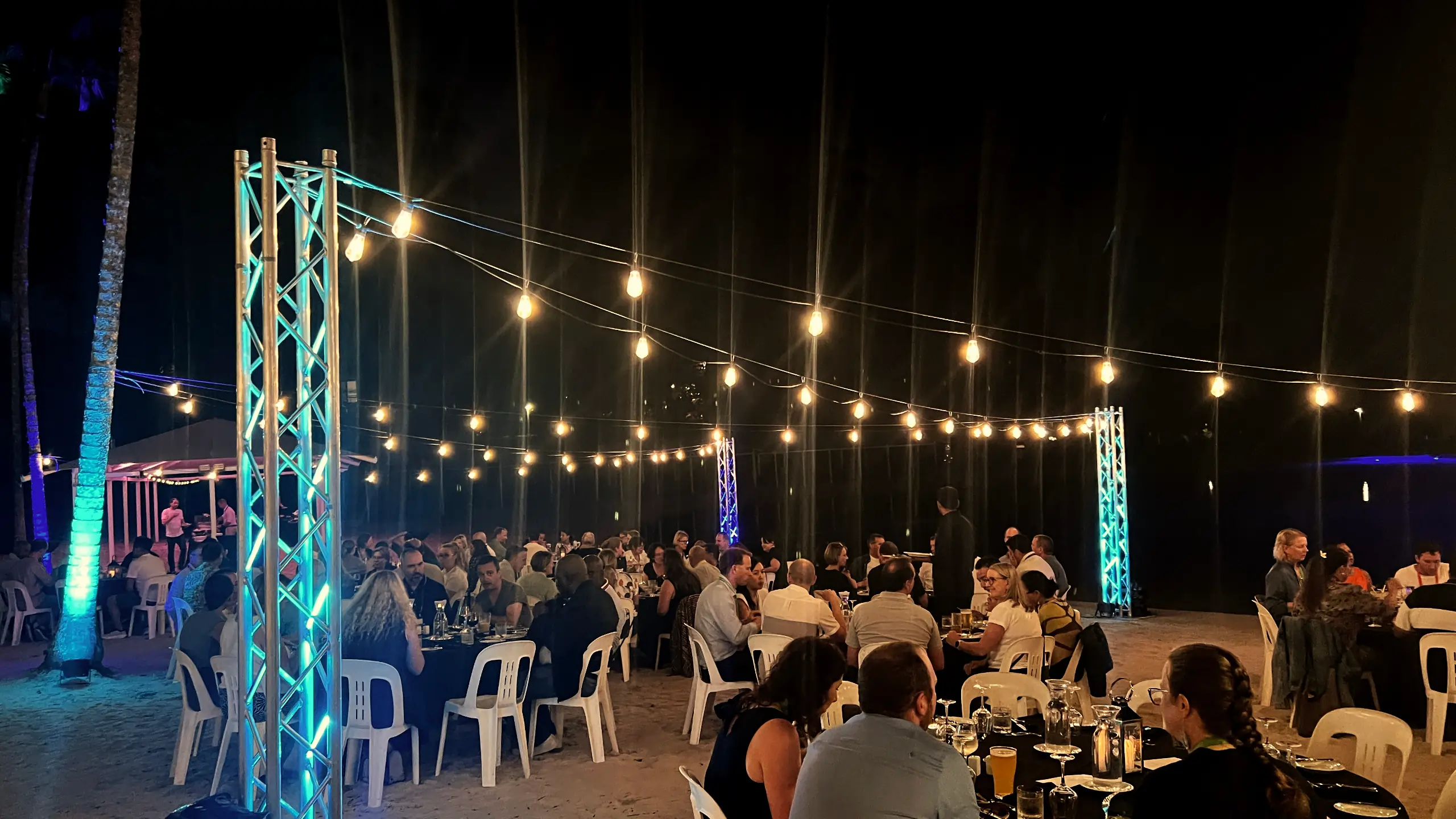
Our crew delivers, rigs and tests everything — you never touch a ladder.
04
Enjoy & packdown
Enjoy the night. When it wraps, we come back and pack it all down.
Frequently asked
A typical professional install takes 2 to 3 hours on site. That covers confirming the plan against the real space, setting anchor points, flying and tensioning the catenary wire, attaching the festoon, running power and testing every span. Larger installs or tight venue access windows just mean a bigger crew rather than a longer day.
Catenary wire is a tensioned stainless steel cable flown between anchor points, and the festoon attaches to it along its length. The wire carries the weight; the lighting cable only carries electricity. That separation keeps runs straight and the sag even all night, where festoon hung by its own cable stretches, droops and strains its connections within hours.
Yes. We bring freestanding poles on weighted bases and fly the catenary wire between them, so open paddocks, courtyards and beachside sites are all workable. Raised 3 metre beams ($200) lift runs over dance floors and walkways. Nothing gets dug in or fixed to the venue, and the site is left exactly as we found it.
More than the straight-line distances suggest, because zigzag canopies and sag consume length. As a rough scale: 60 metres ($895) suits an intimate dining area or feature run, 120 metres ($1495) covers a full reception canopy, and 200 metres ($1945) does dining, dance floor and entry. Send us measurements or photos and we'll quote exact quantities within 24 hours.
Very little. Our LED festoon draws 20 watts per 5 metre string, so a full 50 metre run uses just 200 watts. The real constraint is distribution: we run a maximum of 50 metres per power source to avoid voltage drop, so larger canopies are fed from multiple points. We also keep lighting off circuits shared with catering, which is what prevents tripped breakers mid-event.
Yes. Our festoon is IP65 rated, meaning the strings and connections are sealed against rain and dust, and every item is electrically tested and tagged before it leaves the warehouse. We also weather-plan the install itself — sealed outdoor connections, protected power feeds and rigging tensioned with coastal wind in mind — so a wet forecast doesn't threaten the event.
Yes, always. Festoon packages at $895 (60 metres), $1495 (120 metres) and $1945 (200 metres) all include delivery, professional installation and packdown. Standard hire is 24 hours, and extended rental is $145 per additional 24 hours. We pack down after your event, usually the next morning, so nobody at your event touches a ladder or a cable.
For a permanent string on your own deck, a kit is fine. For an event, kits fail predictably: no catenary rigging so runs sag unevenly, under-ordered quantities, overloaded single power feeds and nobody to pack down at midnight. Professional hire from $895 includes measured quantities, rated rigging, planned power and packdown — usually for less than the kit's true cost.
Keep reading
More event lighting guides
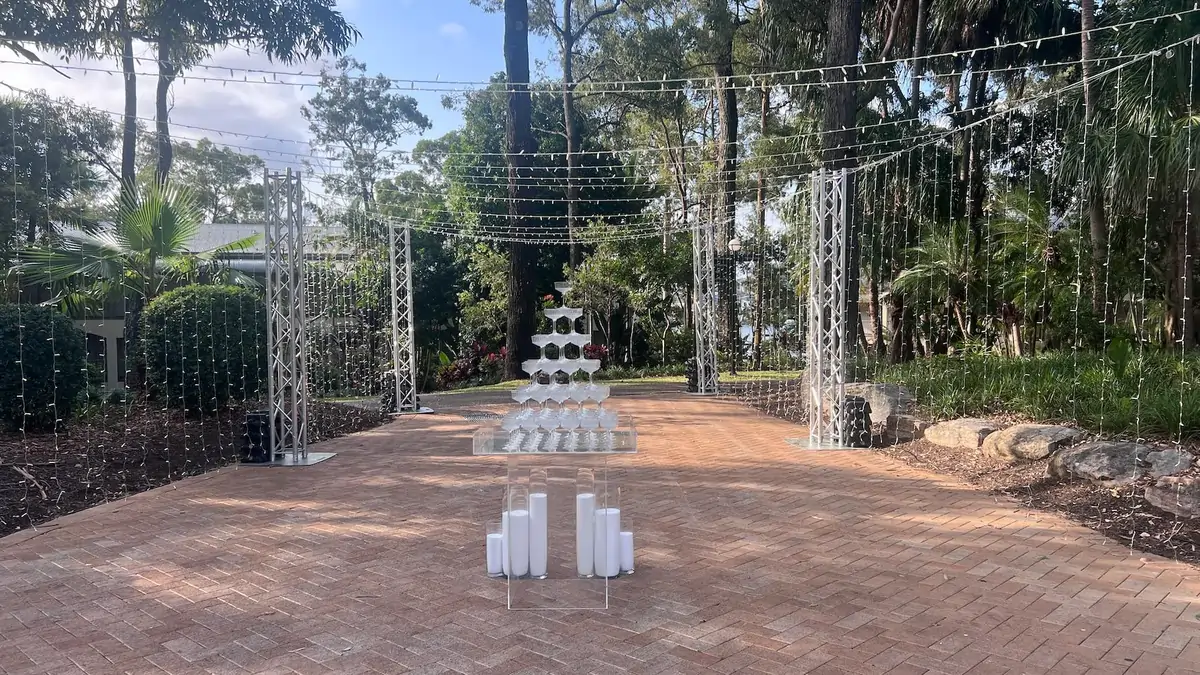
Byron Bay Hinterland Wedding Lighting Guide
Byron Bay hinterland wedding lighting guide covering barns, tipis and paddock venues — power, rigging and sunset timing…
Read more →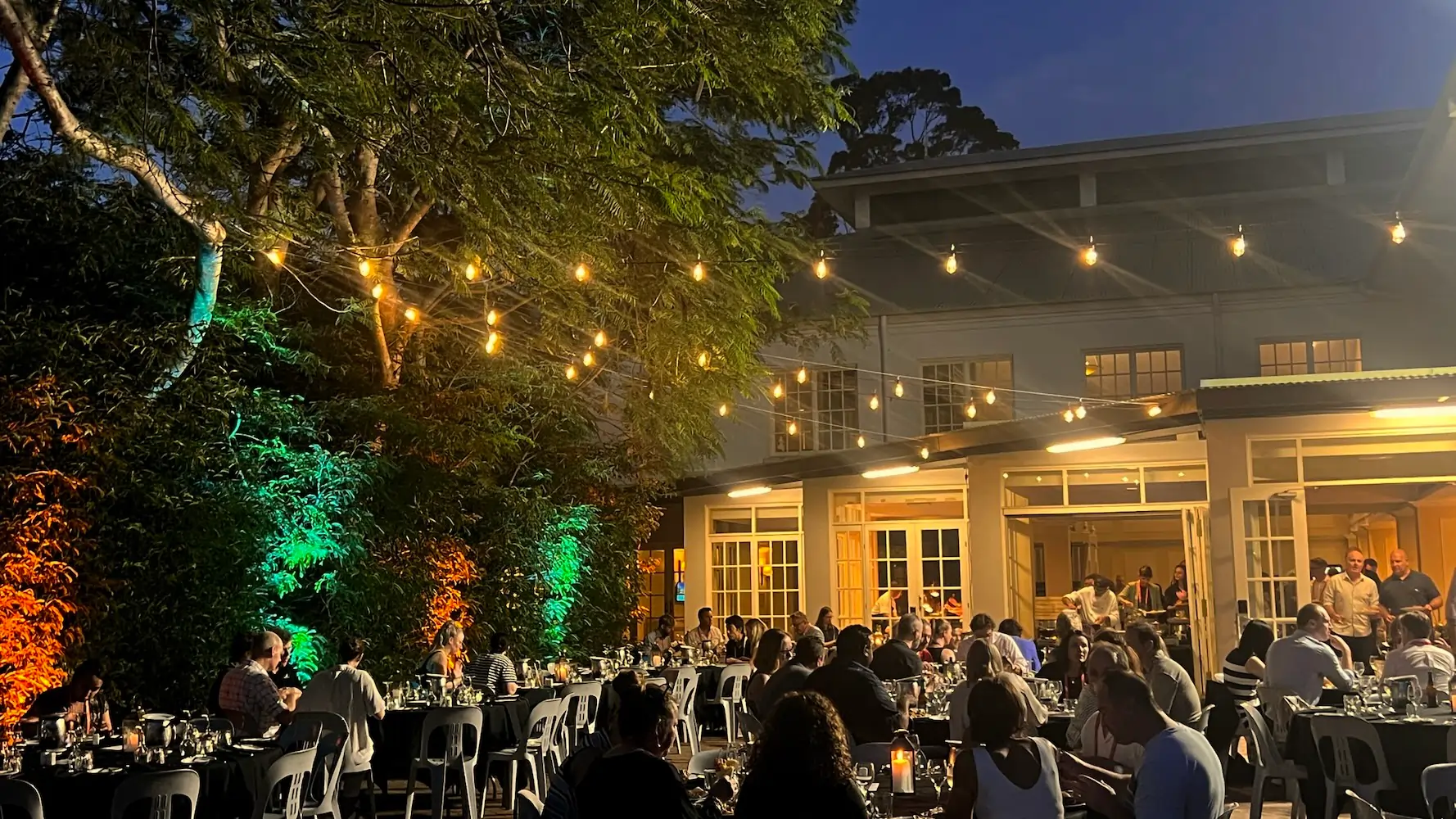
Choosing Event Lighting on the Gold Coast
How to choose event lighting hire on the Gold Coast — venues, coastal weather and what to ask suppliers — from a crew wi…
Read more →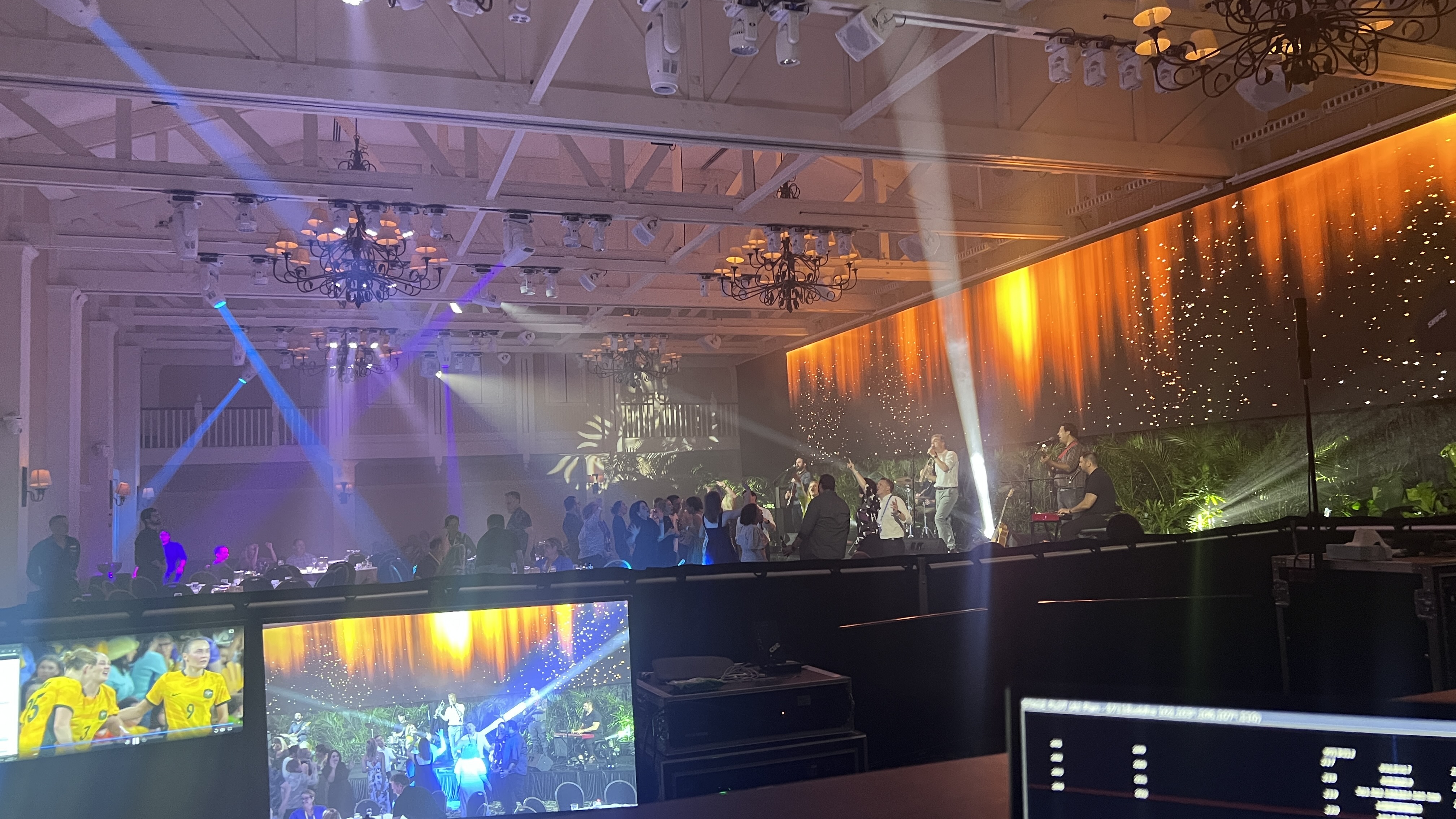
Corporate Event Lighting Guide
How to plan lighting for galas, conferences and launches — branding, stage wash and AV — from a crew with 10+ years ligh…
Read more →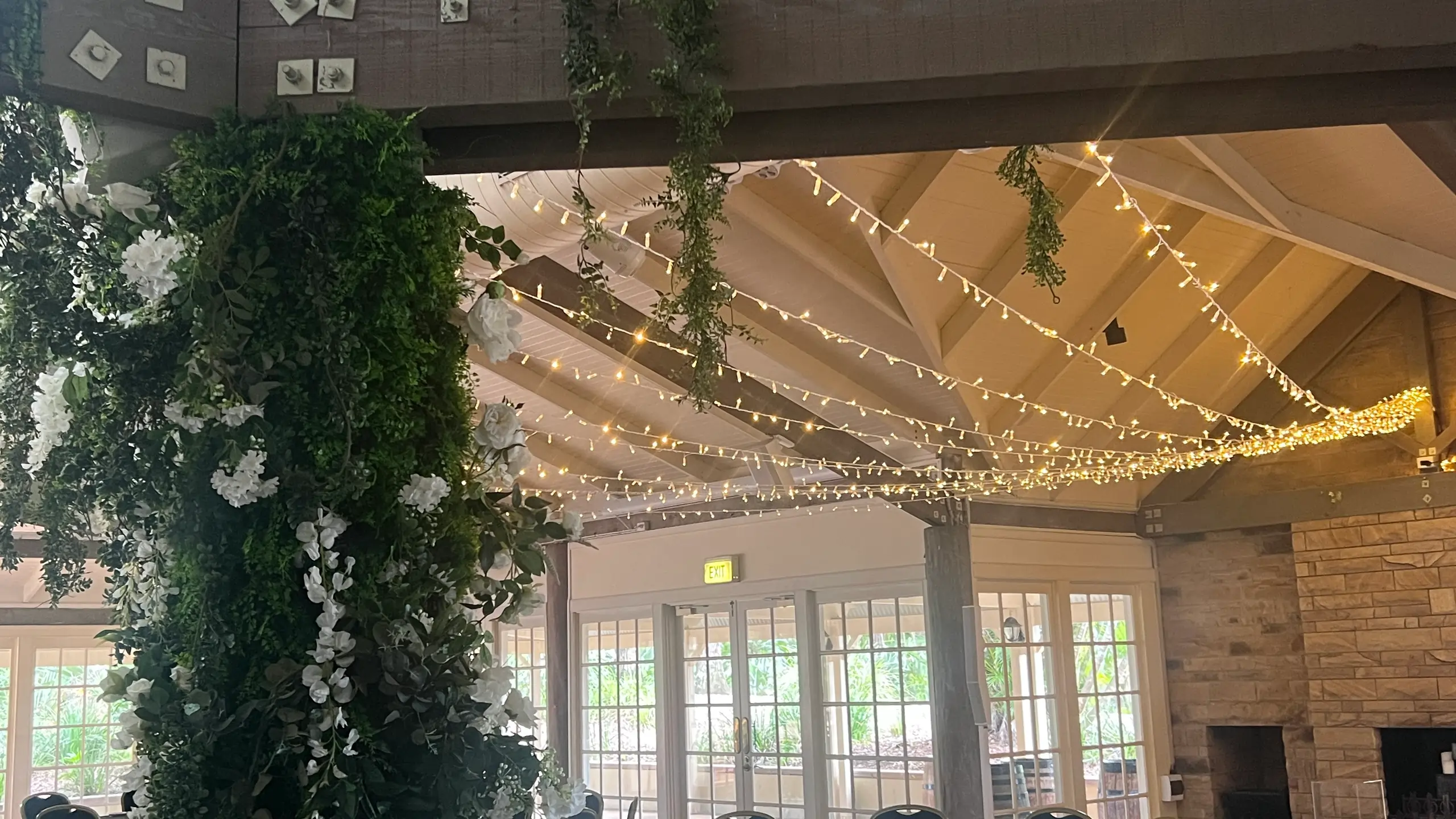
Dance Floor Lighting Ideas
Dance floor lighting ideas for weddings and events — canopies, colour, DMX moments and lasers — from the crew that light…
Read more →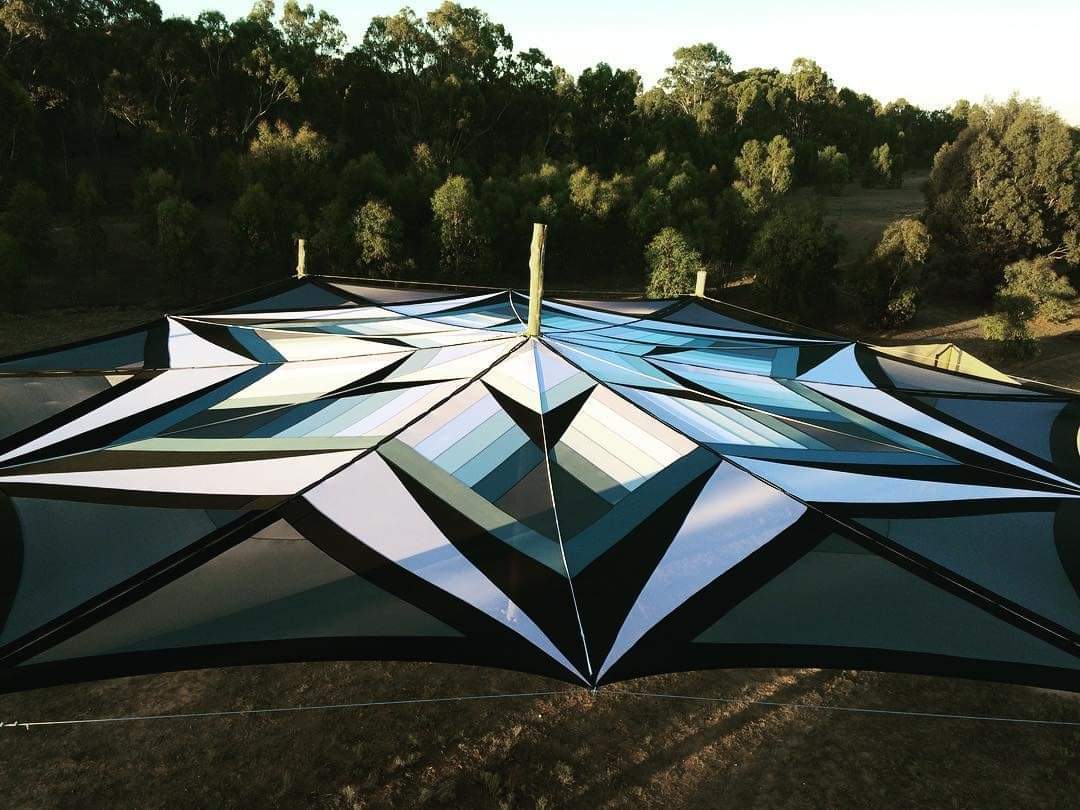
The Event Lighting Checklist
The checklist we run before every install — venue, power, weather, timing and safety — so your event lighting goes right…
Read more →
Event Lighting: Hire vs Buying — The Honest Maths
Event lighting hire vs buying compared honestly — real costs of owning 60m of festoon, when buying makes sense, and what…
Read more →
Festival Lighting Explained
How festival lighting works — stage rigs, DMX programming, lasers and site lighting — explained by operators with 10+ ye…
Read more →
Festoon vs Fairy Lights: Which Should You Hire?
Festoon or fairy lights? How the two compare on look, coverage and cost — and when to combine them — from installers wit…
Read more →
Gala Dinner & Awards Night Lighting Guide
Gala dinner and awards night lighting guide — room wash, branded uplighting, gobo logo projection, stage lighting and AV…
Read more →How Much Does Event Lighting Cost?
What event lighting hire really costs — festoon, uplighting, stage rigs and projection — and what drives the price. Hone…
Read more →How to Light a Wedding Reception
Step-by-step guide to lighting a wedding reception — zones, layers and timing — from installers who've lit hundreds of r…
Read more →LED Uplighting vs Festoon Lighting: What's the Difference?
LED uplighting vs festoon lighting compared — what each does, what each costs and how to combine them — from installers…
Read more →Marquee Lighting Guide
How to light a marquee properly — canopies, pole wraps, uplighting and dance floors — from installers who rig marquees w…
Read more →Outdoor Wedding Lighting Tips
Practical outdoor wedding lighting tips — weatherproofing, power, trees and timing — from installers who light coastal w…
Read more →Projection Mapping Explained
What projection mapping is, how it works and what it costs — buildings, stages and reveals — explained by technicians wh…
Read more →Uplighting Colour Guide: Choosing the Right Palette
How to choose uplighting colours for weddings, galas and events — warm vs cool, brand colours, and the shades that flatt…
Read more →Venue Power for Event Lighting: What You Actually Need
Venue power for event lighting explained — 10A vs 15A circuits, real wattage numbers, when you need a generator, and the…
Read more →The Complete Wedding Lighting Guide
Plan your wedding lighting — ceremony, reception and dance floor — with a crew that's lit weddings across QLD and NSW fo…
Read more →Wet Weather Event Lighting: Planning for QLD and Northern NSW
Wet weather event lighting for QLD and Northern NSW — IP65 ratings explained, storm and wind planning, wet season tips a…
Read more →Get a lighting quote in 24 hours.
Tell us about your event — we'll come back with options and a price.