
Power Planning
How much power does event lighting actually need?
Power is the question almost nobody asks until something trips. Here's how to read your venue's power, what lighting genuinely draws, and when a generator earns its keep. Written by the crew that plans, installs and packs down event lighting across the Gold Coast, Byron Bay, Brisbane and the Northern Rivers.
Start Here
Why power is the first question, not the last
Most event lighting problems we get called in to rescue have nothing to do with the lights themselves. They come down to power: a paddock with one outdoor socket, a heritage hall where the lighting circuit also runs the kitchen, or a marquee 80 metres from the nearest power point. The gear was fine. The plan wasn't.
The good news is that modern LED lighting draws far less power than most people assume, so once you understand a few basics you can plan almost any site with confidence. In 10+ years of AV and events work, we've lit beaches, hinterland properties, rooftops and function rooms, and the process always starts the same way: work out what power exists, work out what everything will draw, then design the lighting to fit — or bring the power with us.
This guide walks through that process in plain English. No electrical background needed. And if you'd rather skip the homework entirely, that's a normal thing to do — power planning is included in every quote we send, and quotes come back within 24 hours.
One reassurance before we start: in over a decade of installs we have never met a site we couldn't power. Every venue, paddock and beach has a workable answer. The only question is whether that answer gets designed calmly in advance or improvised on the day, and the whole point of this guide is to make sure it's the former.
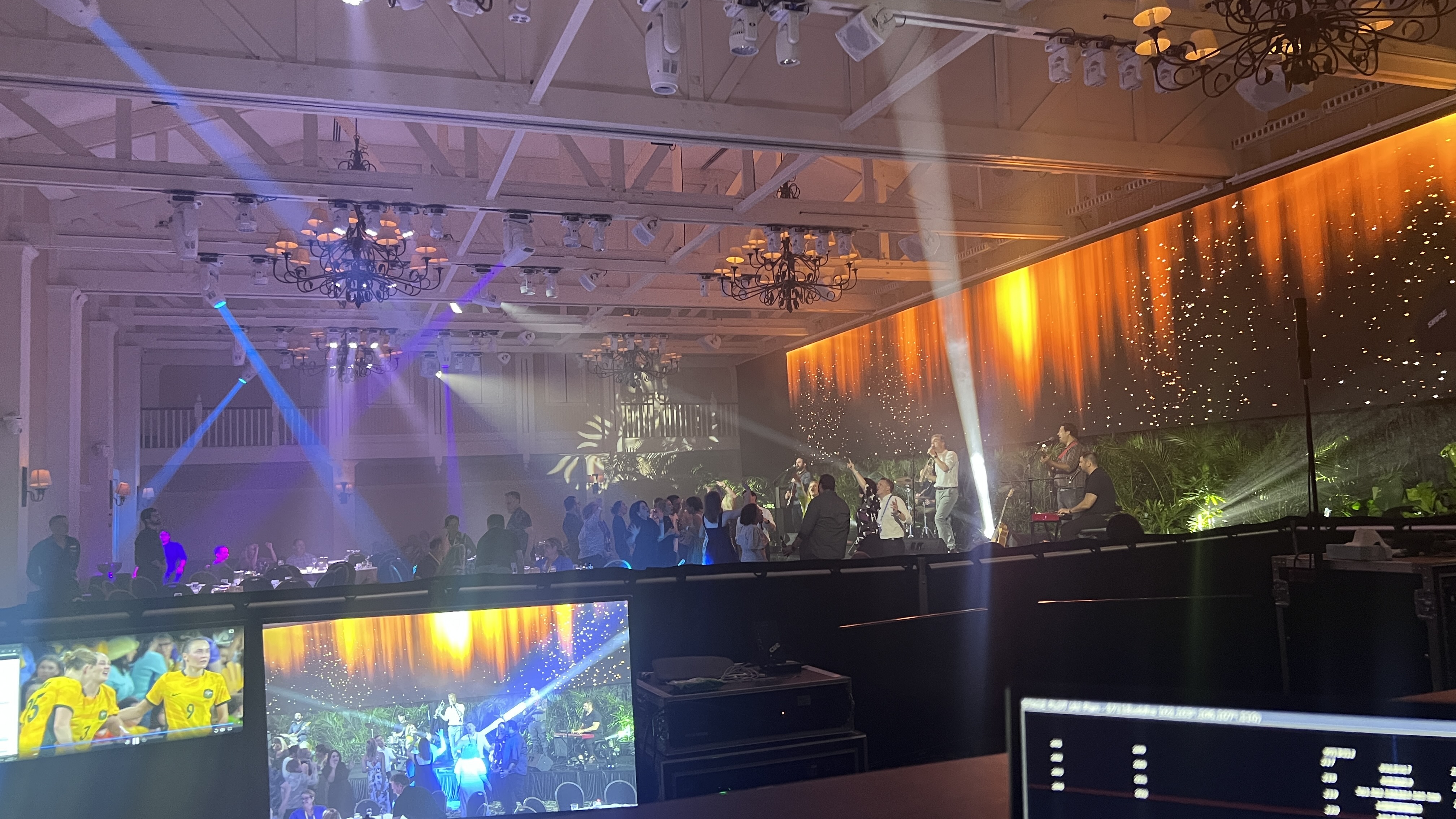
The Basics
Reading a venue's power: 10A vs 15A circuits
Australian venues generally give you two kinds of power point. A standard 10 amp socket is the one in your house, and on our 240 volt supply it can deliver about 2,400 watts. A 15 amp socket looks almost identical but has a wider earth pin, and it delivers about 3,600 watts. You'll find 15A sockets in commercial kitchens, sheds, caravan parks and better-equipped function venues.
The number of sockets on the wall is not the number of circuits, and this is the trap. Six power points in a hall might all run back to one breaker. Load them all up and the whole lot trips at once — usually right as the speeches start. What actually matters is:
- How many separate circuits serve the event space, not how many sockets.
- What else shares those circuits: kitchens, cool rooms, air conditioning and urns are the usual silent load hogs.
- Where the sockets are: a socket 60 metres from your marquee needs proper outdoor-rated cabling and weather-protected connections, not a domestic extension lead.
A quick email to your venue manager answers most of this. If they don't know, that's useful information too — it tells us to design conservatively or bring our own distribution.
Larger commercial venues sometimes offer three-phase power as well: a heavier supply, usually a big round five-pin outlet, designed for serious loads like full stage rigs and commercial kitchens. If your venue has it, that's excellent news for big productions, but it needs proper distribution equipment to break it down into usable circuits — never something to improvise. For the typical wedding or function, standard 10A and 15A circuits are what you'll be working with, and as the next section shows, they're more capable than most people expect.
Real Numbers
What event lighting actually draws
Here's where LED changes everything. Our festoon lighting uses LED Edison-style bulbs, 25 bulbs per 5 metre string at 20 centimetre spacing, and each 5 metre string draws just 20 watts. That means:
- 60 metres of festoon: about 240 watts — one tenth of a single 10A circuit.
- 120 metres: about 480 watts. Less than a kitchen kettle.
- 200 metres: about 800 watts, still comfortably on one domestic circuit.
Older incandescent festoon drew many times that, which is why so much received wisdom about lighting and power is out of date. The practical limit on festoon isn't wattage at all — it's run length. We cap runs at 50 metres per power source to keep voltage stable along the string, so a 200 metre install is planned as multiple runs fed from different points rather than one giant daisy chain.
LED uplighting is similarly frugal — a full perimeter of uplights typically draws less than a single household appliance. The lighting is almost never the problem. What fills circuits is everything around it.
One accessory worth mentioning here is dimming. Adding a dimmable controller ($145) to a festoon package doesn't change the power maths — it changes what you can do with it. Full brightness while guests arrive and find their seats, then a slow pull down to a warm glow as dinner lands, all from one controller and the same modest draw. At 2700K warm white, dimmed festoon is about the most flattering light a camera will ever meet.
The Full Picture
How the loads add up on event day
An event is never just lighting. By the time doors open, a typical reception or function is running a PA system, a DJ or band rig, catering equipment, a coffee machine, fridges, phone chargers and sometimes fans or heaters. Individually these are small. Together they're the reason breakers trip.
The heavy hitters are almost always heat-based: urns, pie warmers, coffee machines and portable heaters can each draw 1,500 to 2,400 watts — one appliance can fill an entire 10A circuit on its own. A band's backline and PA is usually moderate but spiky. Dance floor lighting and moving fixtures draw more than festoon but are still modest in LED form.
The planning rule we use is simple: put lighting, audio and catering on separate circuits wherever possible, and never share a circuit with anything that makes heat. For a marquee wedding on a private property, that usually means mapping every circuit on the house and shed before we design anything. It's twenty minutes of work that prevents the one failure guests will actually remember.
To make it concrete, here's a rough load budget for a 100-guest reception in a hall with three circuits. Circuit one: 120 metres of festoon overhead plus perimeter uplighting, roughly 700 watts all up, with headroom to spare. Circuit two: the band's PA, backline and the DJ changeover rig. Circuit three: catering — the urn and coffee machine alone can claim most of it. Nothing shares, nothing trips, and if the venue produces a fourth circuit we'd still keep the coffee machine on its own one. That's the entire discipline: know the loads, keep the heat-makers isolated, leave headroom on everything.
Off-Grid Sites
When you genuinely need a generator
Plenty of the best event sites in our region — beaches, headlands, paddocks, hinterland clearings — have no power at all, or one lonely socket a long way from where you want the magic to happen. That's not a dealbreaker. It just means the power comes with the lighting.
You genuinely need a generator when:
- There's no mains power within a safe, practical cabling distance of the install.
- The available circuits are already committed to catering and audio, with nothing left over.
- The site's wiring is unknown or untrustworthy — old farm sheds are charming right up until they aren't.
Because LED lighting draws so little, the generator that covers it can be small and quiet — this isn't a construction-site unit rattling behind the ceremony. Placement matters more than size: downwind, away from guests, with cable runs planned so nobody ever sees or trips on them. Generator supply, distribution and cabling is part of our technical production service, and for outdoor sites it's planned alongside the outdoor installation itself, not bolted on afterwards.
Beach ceremonies deserve a special mention because they're such a big part of events on the Gold Coast and around Byron Bay. There is no socket on the sand, councils have rules about where equipment can sit, and whatever powers the lighting has to be quiet enough not to intrude on the vows. All solvable — we've lit plenty of beachfront events — but it's exactly the kind of site where the power plan and the lighting design have to be drawn on the same page from the beginning.
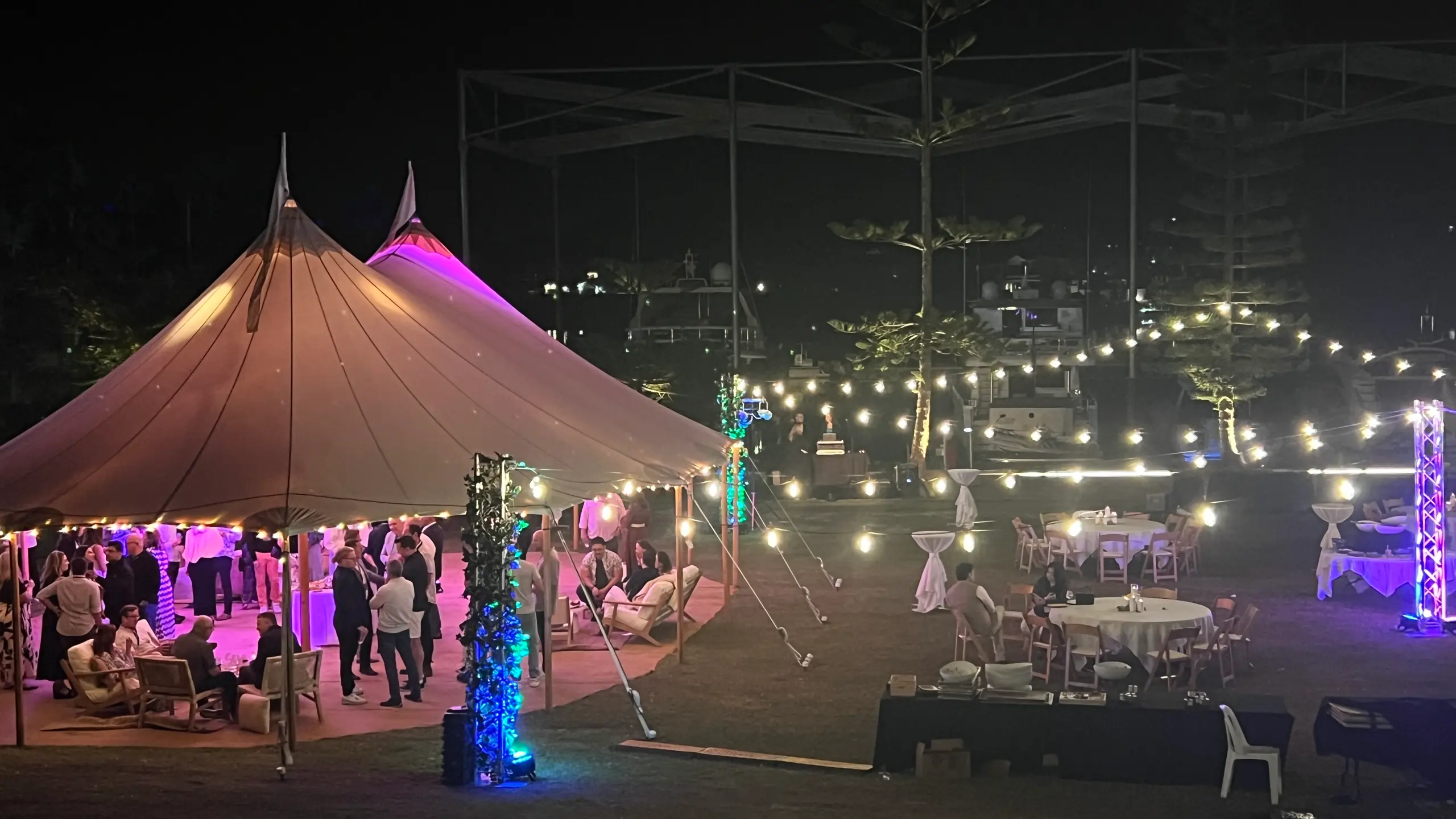
Your Homework
Five questions to ask your venue
You don't need to become an electrician. You just need answers to five questions, and any decent venue coordinator can supply them in one reply:
- How many separate circuits serve our event space, and are any of them 15 amp?
- What else runs on those circuits? Specifically kitchen, cool room and air conditioning.
- Where are the power points relative to where the lighting, band and catering will actually be?
- Are outdoor areas powered, and are those sockets weather-protected?
- Do you allow generators on site, and is there a spot you prefer them?
A useful sixth, if the coordinator is willing: a photo of the switchboard. It sounds odd to ask, but one clear photo tells us the number of circuits, their ratings and their labels in ten seconds flat.
Forward the answers to us with your enquiry and we can usually confirm the whole power plan sight unseen. For venues we've worked before — and after 10+ years across the Gold Coast, Brisbane, Byron Bay and the Northern Rivers, that's a lot of venues — we often already know the answers, including the quirks the venue forgot to mention.
A tip on reading the replies: precision is a good sign. A coordinator who answers "two dedicated 15A circuits on the eastern wall, kitchen is separate" runs a venue where external suppliers have an easy time. A reply of "there's heaps of power, never had a problem" isn't a red flag exactly, but it's a prompt for us to arrive with extra cabling and our own distribution, and to plan as though every socket shares one breaker until proven otherwise. Vague answers cost nothing when the contingency is already in the van.
What We Handle
The part you can hand over completely
Everything in this guide is work we do on every single job, whether you've read it or not. When you book with us, the power plan is built into the quote: we confirm circuits with the venue, design runs within the 50 metre limit, bring outdoor-rated cabling and distribution, and arrange generator supply where a site needs it. Delivery, a typical 2 to 3 hour install, and packdown are included in every festoon package, starting from $895 for 60 metres.
Safety sits underneath all of it. Every fixture, lead and connection we hire out is tested and tagged, cable runs are secured and protected, and outdoor connections are rated for weather — the full detail is on our safety and compliance page. That's the difference between hired lighting and a DIY setup running on hope and a domestic power board.
If you're planning an event anywhere from Brisbane to Byron Bay, tell us the site and we'll tell you the plan. The most useful things to include in your enquiry are the venue name, whether any part of the event is outdoors, and roughly what you're imagining overhead — from there the power questions are ours to chase, not yours. Get in touch and you'll have a quote back within 24 hours, power plan included.
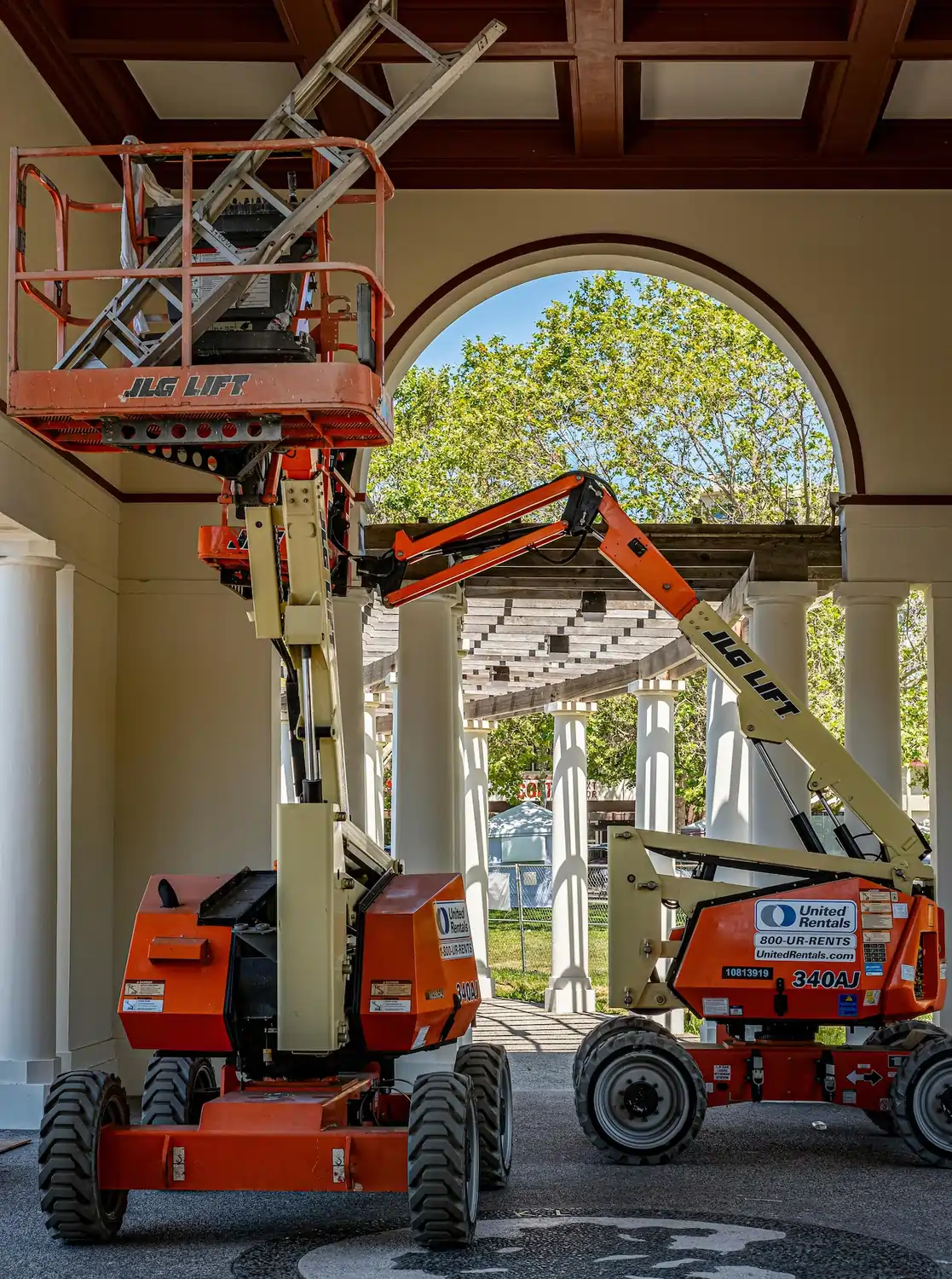
How it works
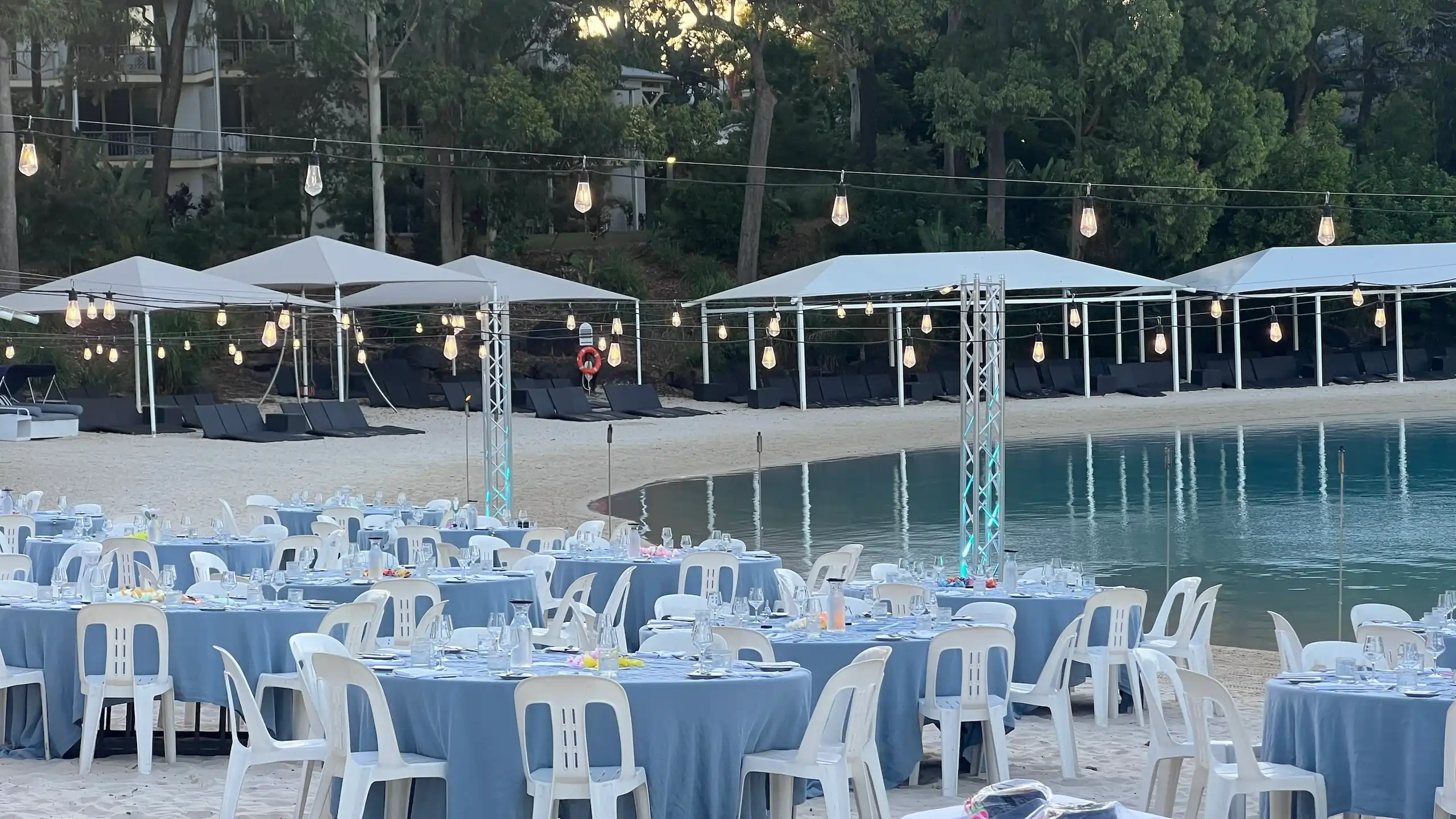
01
Get a quote
Tell us about your event and venue — we come back with options and a price within 24 hours.
02
Design & plan
We spec the right gear for your space, with renders for bigger builds so you see it before the night.
03
Delivery & install
Our crew delivers, rigs and tests everything — you never touch a ladder.
04
Enjoy & packdown
Enjoy the night. When it wraps, we come back and pack it all down.
Frequently asked
Very little. Our LED festoon draws 20 watts per 5 metre string, so a 60 metre install uses about 240 watts and even 200 metres only draws about 800 watts. That's comfortably within a single standard 10 amp circuit, which supplies about 2,400 watts. The real constraint is run length, not wattage — we cap each run at 50 metres per power source.
A 10 amp socket is the standard household power point and supplies about 2,400 watts. A 15 amp socket has a wider earth pin and supplies about 3,600 watts — you'll find them in commercial kitchens, sheds and well-equipped venues. A 15A plug won't fit a 10A socket, and adapting between them should be left to properly rated equipment.
Only if the site has no mains power within safe cabling distance, or the existing circuits are already committed to catering and audio. Because LED lighting draws so little, a small quiet generator usually covers the whole lighting design. We arrange generator supply, placement and cabling as part of the install when a site needs it.
Almost always because too many things share one circuit — not because any single item is faulty. Heat-based appliances are the usual culprits: urns, coffee machines and heaters can each draw 1,500 to 2,400 watts. The fix is planning: put lighting, audio and catering on separate circuits and never share a circuit with anything that makes heat.
Usually, yes. A full 200 metre LED festoon install draws about 800 watts, which a standard household socket handles easily. The catch is distance and weather — cabling from the house to the install needs to be outdoor-rated and properly protected, and runs are limited to 50 metres per power source to keep voltage stable.
Five things: how many separate circuits serve the event space, whether any are 15 amp, what else shares those circuits (kitchen, cool room, air conditioning), where the sockets actually are, and whether generators are allowed on site. Forward the answers with your enquiry and we can usually confirm the full power plan before we've set foot on site.
Yes. Every fixture, lead and connection we hire is tested and tagged, our festoon is IP65 rated for outdoor use, and installs use outdoor-rated cabling with weather-protected connections. Most venues ask for exactly this before allowing external suppliers, and we provide the documentation as standard.
We handle it. Power planning is built into every quote: we confirm circuits with your venue, design runs within safe limits, bring our own distribution and cabling, and arrange a generator where a site needs one. You don't need to engage an electrician for the lighting — a typical install takes our crew 2 to 3 hours, power included.
Keep reading
More event lighting guides
Byron Bay Hinterland Wedding Lighting Guide
Byron Bay hinterland wedding lighting guide covering barns, tipis and paddock venues — power, rigging and sunset timing…
Read more →
Choosing Event Lighting on the Gold Coast
How to choose event lighting hire on the Gold Coast — venues, coastal weather and what to ask suppliers — from a crew wi…
Read more →Corporate Event Lighting Guide
How to plan lighting for galas, conferences and launches — branding, stage wash and AV — from a crew with 10+ years ligh…
Read more →
Dance Floor Lighting Ideas
Dance floor lighting ideas for weddings and events — canopies, colour, DMX moments and lasers — from the crew that light…
Read more →
The Event Lighting Checklist
The checklist we run before every install — venue, power, weather, timing and safety — so your event lighting goes right…
Read more →
Event Lighting: Hire vs Buying — The Honest Maths
Event lighting hire vs buying compared honestly — real costs of owning 60m of festoon, when buying makes sense, and what…
Read more →
Festival Lighting Explained
How festival lighting works — stage rigs, DMX programming, lasers and site lighting — explained by operators with 10+ ye…
Read more →How Professional Festoon Lighting Installation Works
Festoon lighting installation explained — site visits, catenary wire rigging, spans and sag, power planning and why pros…
Read more →
Festoon vs Fairy Lights: Which Should You Hire?
Festoon or fairy lights? How the two compare on look, coverage and cost — and when to combine them — from installers wit…
Read more →
Gala Dinner & Awards Night Lighting Guide
Gala dinner and awards night lighting guide — room wash, branded uplighting, gobo logo projection, stage lighting and AV…
Read more →How Much Does Event Lighting Cost?
What event lighting hire really costs — festoon, uplighting, stage rigs and projection — and what drives the price. Hone…
Read more →How to Light a Wedding Reception
Step-by-step guide to lighting a wedding reception — zones, layers and timing — from installers who've lit hundreds of r…
Read more →LED Uplighting vs Festoon Lighting: What's the Difference?
LED uplighting vs festoon lighting compared — what each does, what each costs and how to combine them — from installers…
Read more →Marquee Lighting Guide
How to light a marquee properly — canopies, pole wraps, uplighting and dance floors — from installers who rig marquees w…
Read more →Outdoor Wedding Lighting Tips
Practical outdoor wedding lighting tips — weatherproofing, power, trees and timing — from installers who light coastal w…
Read more →Projection Mapping Explained
What projection mapping is, how it works and what it costs — buildings, stages and reveals — explained by technicians wh…
Read more →Uplighting Colour Guide: Choosing the Right Palette
How to choose uplighting colours for weddings, galas and events — warm vs cool, brand colours, and the shades that flatt…
Read more →The Complete Wedding Lighting Guide
Plan your wedding lighting — ceremony, reception and dance floor — with a crew that's lit weddings across QLD and NSW fo…
Read more →
Wet Weather Event Lighting: Planning for QLD and Northern NSW
Wet weather event lighting for QLD and Northern NSW — IP65 ratings explained, storm and wind planning, wet season tips a…
Read more →Get a lighting quote in 24 hours.
Tell us about your event — we'll come back with options and a price.